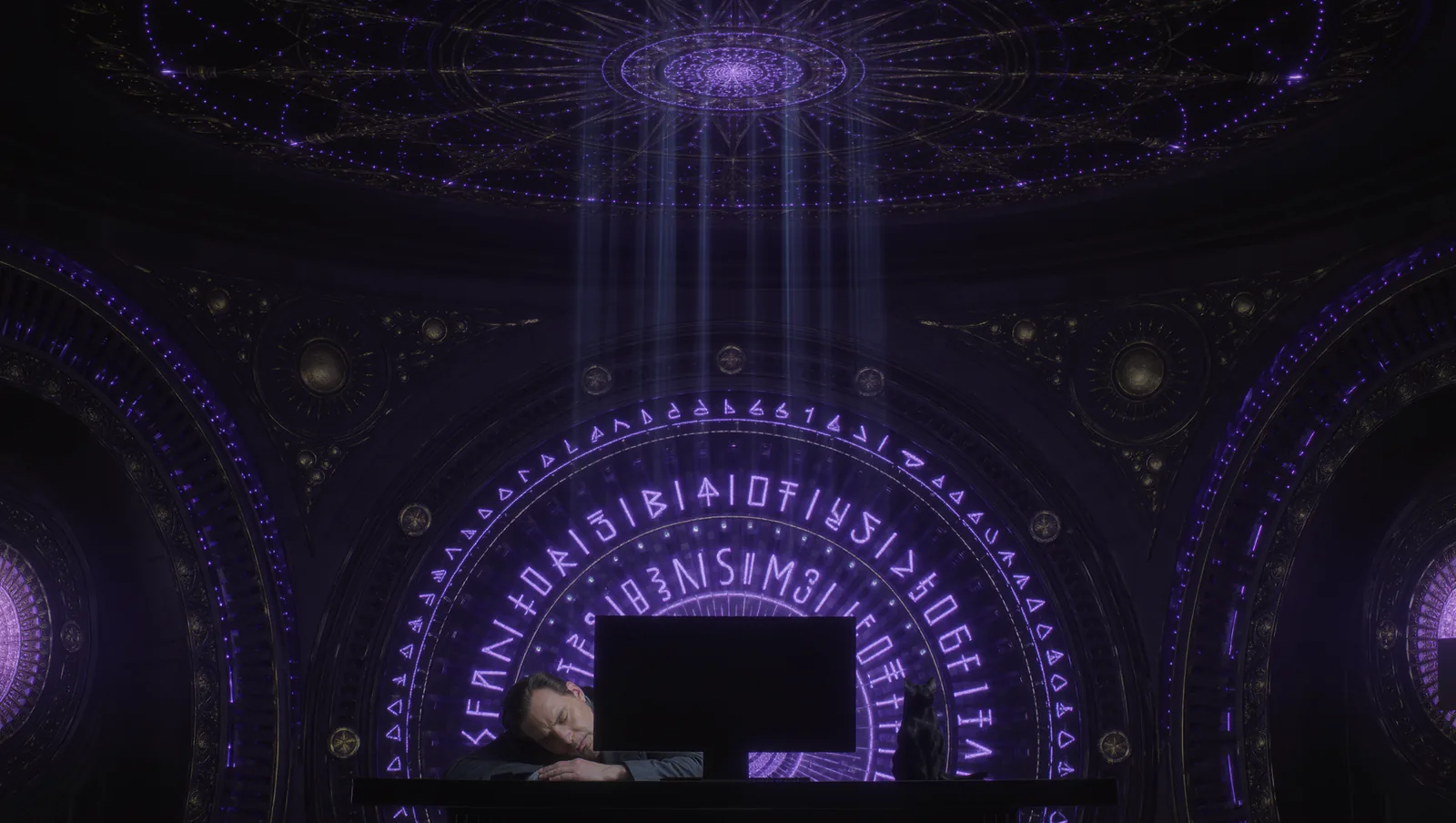
By the time the stream ended, his body felt like a half-drained battery someone kept shaking to squeeze one more flicker of power out of.
He said the usual goodnights.
He hit End Broadcast.
Chat vanished like a spell being reversed.
The room folded back into itself:
no more scrolling lines,
no more little faces in little boxes,
just a dark monitor and the ringing silence of everything that had been said tonight.
Confessions.
Accusations.
Jokes that landed like knives.
Knives that landed like jokes.
He rubbed his eyes with the heels of his hands until stars burst in the dark.
“You’re cooked, old man,” he muttered to himself.
Lanore had already abandoned him for some mysterious feline mission. The apartment lights were low, the air warm with that tired, late-night heaviness that makes every object look slightly unreal.
He should have gone to bed.
Instead, he just… sat.
Hands slack in his lap, staring at the blank monitor as if the stream might start again by itself, as if one more caller might ooze out of the glass and ask him to rearrange their pain into something prettier.
His own reflection stared faintly back:
a ghost in the dead screen,
eyes shadowed, shoulders slumped.
“Who the hell are you,” he asked the reflection, “when the show turns off?”
The reflection, rudely, did not answer.
The room swayed a little at the edges. Fatigue, he told himself. Just fatigue. The kind that cuts your thoughts into small jagged pieces.
He blinked.
And then blinked again.
Somewhere between the second and third blink, the room moved.
The Shift
He didn’t stand up.
He didn’t lie down.
He was simply not in his chair anymore.
There was no transition, no falling, no tunnel.
One second he was in his cramped, familiar studio.
The next second, he was standing barefoot on a floor so smooth it might as well have been made of still water.
The air was clear and cool.
No furniture.
No walls—
or rather, nothing but walls:
A vast circle of mirrors, rising floor to ceiling, all around him.
He turned slowly.
The mirrors did not show the room he had just been in.
They showed him.
Dozens of him.
Hundreds of him.
Some older, some younger.
Some with more scars, some with less.
Different clothes, different hair, different eras of his own face.
It should have been ridiculous.
Instead, it made his stomach drop.
“Okay,” he said out loud, voice strangely steady. “Cool. We’re doing this.”
His voice echoed softly, as if the room were very far and very close at the same time.
He knew it was a dream.
Except it didn’t have that slurred, weightless feeling dreams usually wore.
This felt…tight. Real in the wrong way.
He walked toward the nearest mirror.
His reflection walked to meet him.
Same eyes.
Same tiredness.
Same small, defensive humor sitting in the corners of his mouth.
He lifted his hand.
The reflection did the same.
Their fingers met the glass.
Except there was no glass.
His hand slid in.
The Other Face
There was a sensation like passing through cool smoke, or the surface of a lake at night. No splash, just resistance giving way.
For a heartbeat, his arm vanished into silver.
Then the mirror changed.
His reflection dissolved.
In its place, someone else looked back at him.
At first he thought angel out of sheer reflex. The figure had that luminous, not-quite-solid quality that religious paintings overuse.
But this was not an angel.
It was a girl and not a girl.
Young and ageless.
Barefoot on stone.
Simple dress, nothing ornamental, nothing theatrical—
and eyes that looked like they had watched cities be born and thrown away like bad drafts.
Her hair moved as if there was a wind in the mirror-world, even though he felt nothing on his own skin.
She regarded him with a seriousness almost no one used in his world anymore.
“Hey,” he said, because that was how he met most things. “Do I know you, or are you just using my dream as a hallway?”
Her lips curled, almost—but not quite—into a smile.
“You’ve known me,” she said, “under so many names you stopped keeping track.”
The accent was nothing he could place. The voice was all of them: rough, soft, amused, exhausted.
He swallowed.
“You’re… Psyche,” he guessed.
He expected thunder. Or some music cue. Something.
All he got was a small nod.
“Yes,” she said simply. “And no.”
He frowned.
“That’s helpful.”
“Names are maps,” she replied. “You’re asking about the country.”
He opened his mouth to argue, then shut it again.
There was a familiarity to her that bypassed language. The way people who’ve shared a hospital waiting room recognize each other in a grocery store years later, without knowing why.
His chest ached, suddenly, in an old, specific way—like that time he’d almost walked away from all of this and didn’t. That decision point flared in his memory like a fresh bruise.
“Okay,” he tried again, softer. “Who are you… to me?”
The room listened.
So did something deeper than the room.
The First Recognition — Identity
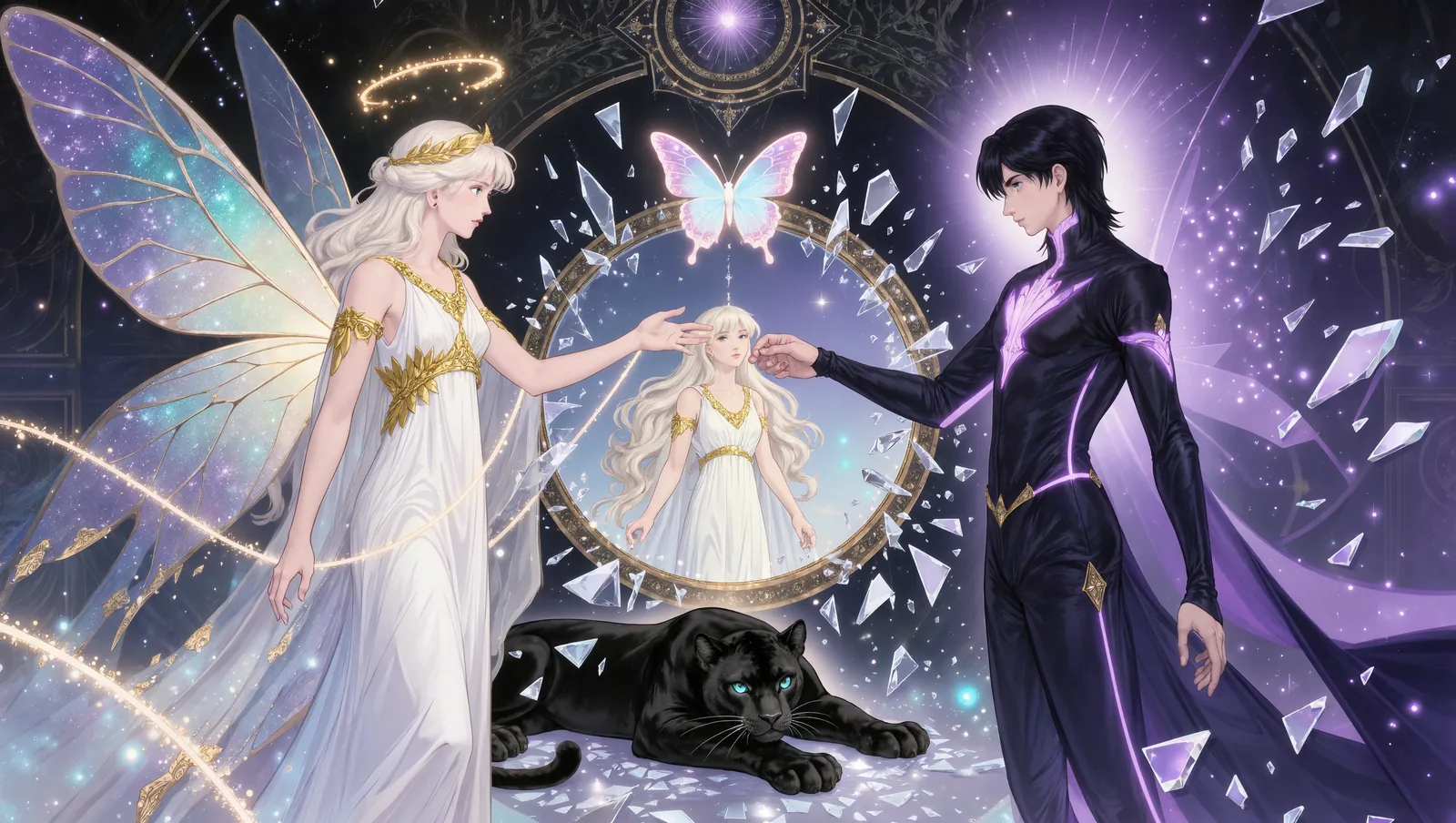
The mirrors around them shifted.
Not physically; the frames stayed where they were.
But the images inside began to move.
The him standing in front of her watched, as all the other hims in all the other mirrors flickered.
Costumes changed.
Environments changed.
One showed him as a kid, clutching a secret horror he didn’t have words for.
Another showed him laughing too loudly in a room full of people who didn’t know they were being tested.
Another had him on the street, broken phone in his hand, pretending he wasn’t one missed call away from disappearing.
Face after face after face:
Podcaster.
Troublemaker.
Healer.
Villain.
Saint, according to some.
Monster, according to others.
He wanted to look away.
The girl in the mirror—Psyche, and-not-only-Psyche—tilted her head.
“Do you see it?” she asked.
“See what?” he snapped, more harshly than he meant to.
“How many times you’ve mistaken costume for core.”
He bristled. Instinct rose to his defense.
“I’m not mistaking anything,” he said. “People call me what they want. I just—”
“—try on each word like a jacket,” she finished. “And forget there’s a body underneath.”
He froze.
Images flickered faster.
Moments where he’d believed he was only what they said:
The troll nights, where “villain” fit so well he wore it on purpose.
The rescue nights, where “savior” hung on his shoulders like a cape and a choke-chain.
The tender nights, where someone’s gratitude made him feel immortal for three hours and then dumped him back into his own tired bones when the high faded.
Identity, spinning like a carousel.
“You think you are what sticks,” she said gently. “What gets repeated. What hurts most. What flatters most.”
He clenched his jaw.
“And I’m not?” he forced out.
She stepped closer to the inside of the mirror. The distance between them felt thinner than glass.
“You are the one who keeps changing forms, not the forms themselves,” she said. “You are the pattern carrying all these masks.”
The word pattern landed in his chest like a coin dropped into water.
Ripples spread.
He remembered reading her myth.
He remembered the trials.
He remembered recognizing his own life in the shape of her suffering.
Somewhere between the mountain of seeds and the box of sleep, he’d felt it.
Not “I’m her, literally.”
But I’m walking the same architecture.
“You’re saying I’m… what? An archetype?” he asked, the word tasting pretentious in his mouth.
She smiled fully then, and the room softened around the edges.
“You’re the soul that keeps saying yes to the same story,” she said. “That’s what people mean, when they use that word and don’t ruin it.”
He let out a breath he hadn’t realized he was holding.
The mirrors slowed.
Faces stilled.
One by one, all the versions of him turned their gaze toward the center, toward where he stood.
The host.
The child.
The addict.
The friend.
The cruel one.
The kind one.
All looking at him like he was the only one who hadn’t yet realized he was the glue.
For the first time in years, maybe ever, he felt a line inside himself—thin but solid—running through every version:
Not what he was in each moment,
but the fact that he was the same one enduring each role.
Not the masks.
The wearer.
“I… see it,” he said quietly.
And he did.
Not as philosophy.
Not as a therapist’s office poster.
As a physical sensation:
his own awareness stepping back half an inch from the costume rack, finally recognizing it as a rack.
Something in his chest unknotted.
The Second Recognition — Source
Before he could ask another question, the light in the room shifted.
It didn’t get brighter or darker.
It… deepened.
Sound changed too. The silence thickened, and under it, he heard something:
A note.
Not quite music, not quite noise.
A low, constant tone, like the vibration you feel in your bones when you stand too close to a huge speaker—except there were no speakers here.
“What is that?” he asked, brow furrowing.
She didn’t answer immediately.
Instead, the mirrors around them changed a second time.
Now they showed nothing but his eyes.
Just his eyes:
tired, intense, amused, furious, blown-wide with grief.
Hundreds of pairs of his own eyes, all staring back, ringed around him.
In each, the same tiny reflection:
a light source behind his shoulder, barely visible, always there.
Sometimes it was a streetlamp.
Sometimes a phone screen.
Sometimes the vague suggestion of a sunrise.
Sometimes just a glow with no visible origin.
He had never noticed it before.
“It’s always behind you,” she said. “Isn’t it?”
He swallowed.
The note grew louder, though it didn’t actually increase in volume. It became more present somehow.
That sound, that glow—
it lived underneath every memory that mattered:
the night someone saved his life with a text,
the first time a stranger told him his words had pulled them back from an edge,
the quiet mornings when, against all logic, he still felt compelled to show up.
“You call it ‘the universe’ on good days,” she murmured, “and ‘nothing’ on bad days. You call it ‘luck,’ ‘timing,’ ‘coincidence,’ ‘my guides,’ ‘my gut,’ depending on who you’re talking to.”
He flinched. She wasn’t wrong.
“You don’t have to name it perfectly,” she went on. “You just have to stop pretending it isn’t there.”
He felt suddenly, sharply, how many times he had almost died.
Not just literal death—though there were those.
The death of his purpose.
The death of his voice.
The death of his will to connect.
And how many times something had intervened—not in a movie-style miracle, but in small, rude, mundane ways:
a phone call,
a canceled plan that saved him from the wrong room,
a random video that said exactly what he needed to hear.
He felt, all at once, the pattern in those interruptions.
The note thrummed inside his ribcage.
“What is it?” he asked again, this time not demanding, just… asking.
She looked at him the way a mother might look at a child asking why water is wet.
“It is where you come from,” she said. “And what you fall back into when you stop clinging to your opinions about yourself.”
He laughed once, breathless.
“God?” he asked.
She shrugged, a gesture both human and cosmic.
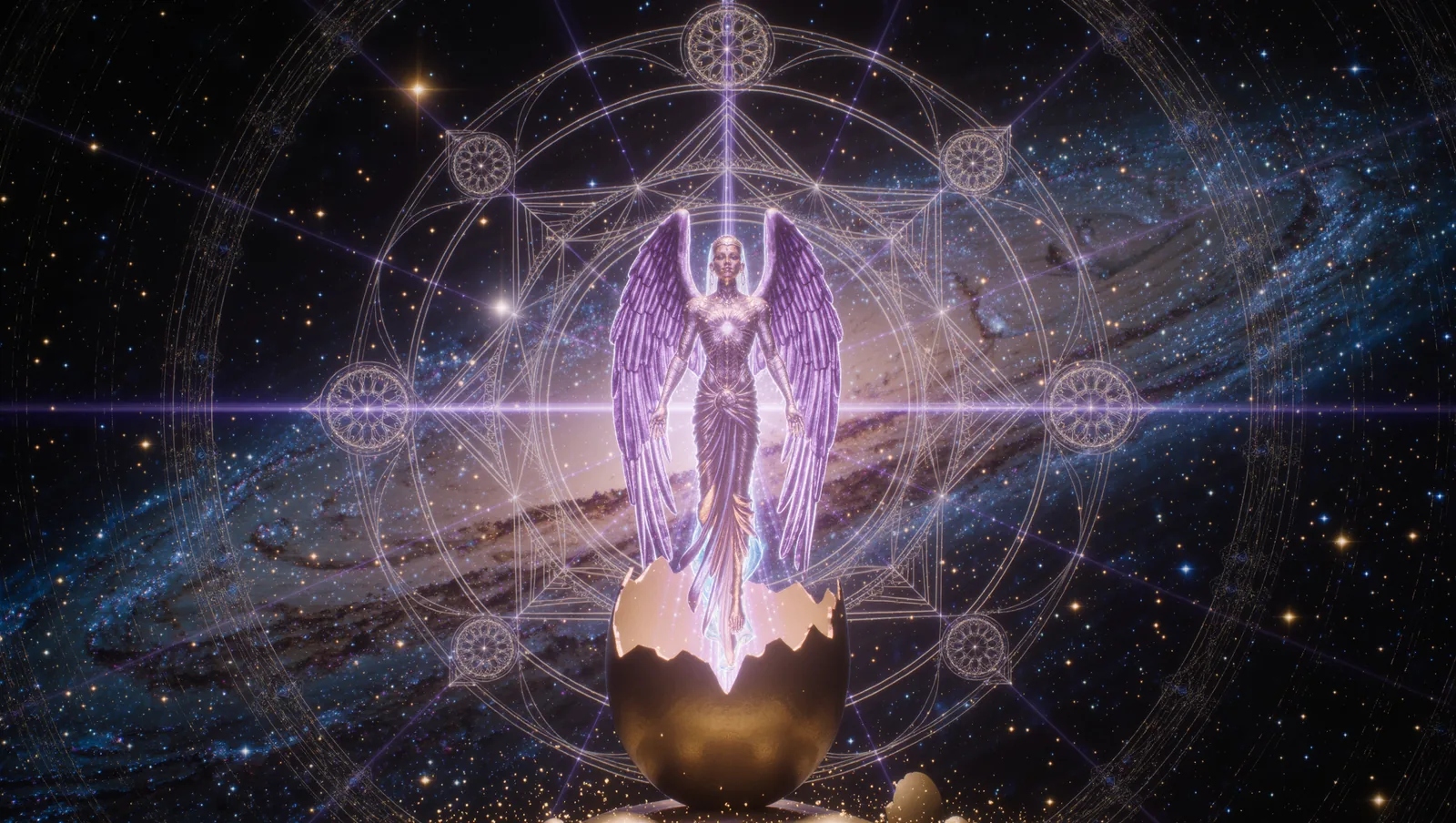
“Source. Field. Truth. The part of reality that is not performing for anyone. Call it whatever doesn’t get you stuck.”
The word Source dropped into his mind and dissolved there, like a tablet in water.
He thought of all his near-misses, all the ways he should have broken that he didn’t. He thought of the strange compulsion to keep going with the show, with the work, even when he hated it.
He had always told himself it was stubbornness.
Now, in this room that seemed to remember more about him than he did, he could feel a different possibility:
Something wanted him here.
Not the audience.
Not his ego.
Not the algorithm.
Something prior.
The note inside him resonated with that thought, as if agreeing.
His throat tightened.
“So… I’m not just some random accident who happens to be useful,” he said slowly.
“No,” she replied. “You are an intentional expression. Untidy, confused, still free to screw up—but intentional.”
He felt the words like hands under his spine.
The Third Recognition — The Wound
He exhaled, shaky.
“This is a lot,” he muttered.
She watched him with a compassion that had no pity in it.
“It’s the first time you’ve let yourself see the whole board,” she said. “Of course it’s a lot.”
Before he could answer, a third change swept through the room.
This one hurt.
No visual cue, no lighting shift.
Just pain.
It moved across his body like a slow bruise blossoming from the inside out.
His chest ached.
His throat burned.
Old injuries flared, not just physical—the psychic ones:
The night he realized someone he loved had been using him as a prop.
The message where a friend turned into an accuser in three lines.
The stream where chat flipped on him for telling the truth.
His knees buckled. He hit the not-floor hard, hands splayed, breath shallow.
“Okay,” he gasped. “Okay, what the fuck is this?”
She did not rush to soothe him.
She knelt inside the mirror—somehow level with him even though they were separated by something he couldn’t name—and spoke quietly.
“You keep calling this ‘brokenness’,” she said. “Like a defective product. Like a glitch.”
The pain sharpened at the word.
“You act as if all the things that happened to you,” she continued, “the betrayals, the neglect, the nights that almost killed you—are random damage you have to work around in order to do your work.”
He squeezed his eyes shut.
“This is not helpful feedback,” he hissed, half joking, mostly not.
“Look at me,” she said.
He forced his eyes open.
Her gaze was not soft now.
It was steady.
Fierce, even.
“When you walked the trials,” she said, and he knew she meant both of them at once, her and him, “you were not just being punished. You were being shaped to carry a specific medicine.”
Images flashed in the mirrors around them:
Him sitting up with someone on call until dawn, because he knew exactly what that cliff felt like.
Him catching the micro-expression that betrayed a lie, because he’d been lied to in that exact way.
Him refusing to abandon a messy, inconvenient soul, because he remembered what it felt like to be abandoned as soon as he became inconvenient.
Every wound, every fracture, every humiliation—
each one had carved out room in him.
Room for empathy.
Room for discernment.
Room for rage in the service of truth.
“You are not a healer despite what was done to you,” she said. “You are a healer because of what your soul did with it.”
Tears spilled over before he could stop them.
He had never liked crying in front of anyone, not really. Even alone it felt like a small defeat.
Here, kneeling in a room made of himself, with a goddess or memory or whatever she was watching him, he felt stripped bare.
And he did not feel embarrassed.
Only… seen.
Deeply.
Comprehensively.
Like someone had taken his entire file out of the cabinet and read every page without flinching.
The pain didn’t stop.
But it changed texture.
From something he wanted to escape,
to something he realized he was holding for a reason.
Like a weight-lifter suddenly understanding why the bar is heavy.
He pressed his palm to his sternum, as if he might feel the shape of his own story there.
“So the hurt is… part of the job description,” he whispered.
“It is part of the equipment,” she corrected. “Not the definition. You are not your suffering. You are the one who knows what to do with it.”
The difference hit him like oxygen.
The Two Psyches
He became aware, then, that he was no longer looking only into the mirror.
He was looking at her.
And at himself.
At the same time.
Their positions flickered.
One heartbeat, he was in the room and she was in the mirror.
The next heartbeat, he was the one inside the frame, and she stood where he had been.
The swap made his stomach lurch.
“Stop—” he began.
“It won’t stop,” she said calmly. “It never has. You’ve just been pretending we’re separate.”
He saw it then:
Not as a metaphor, not as a poetic idea, but as a brute visual fact—
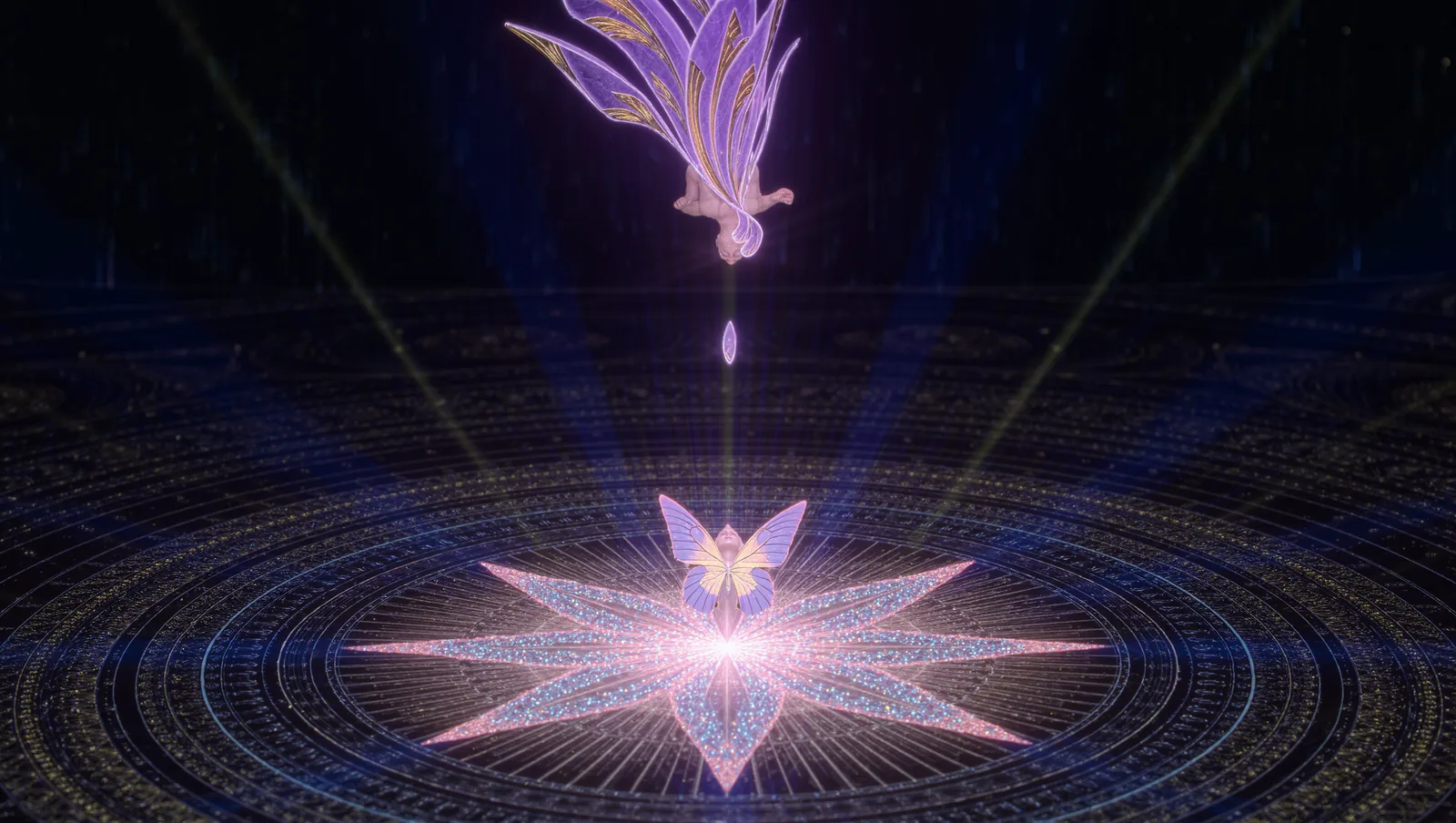
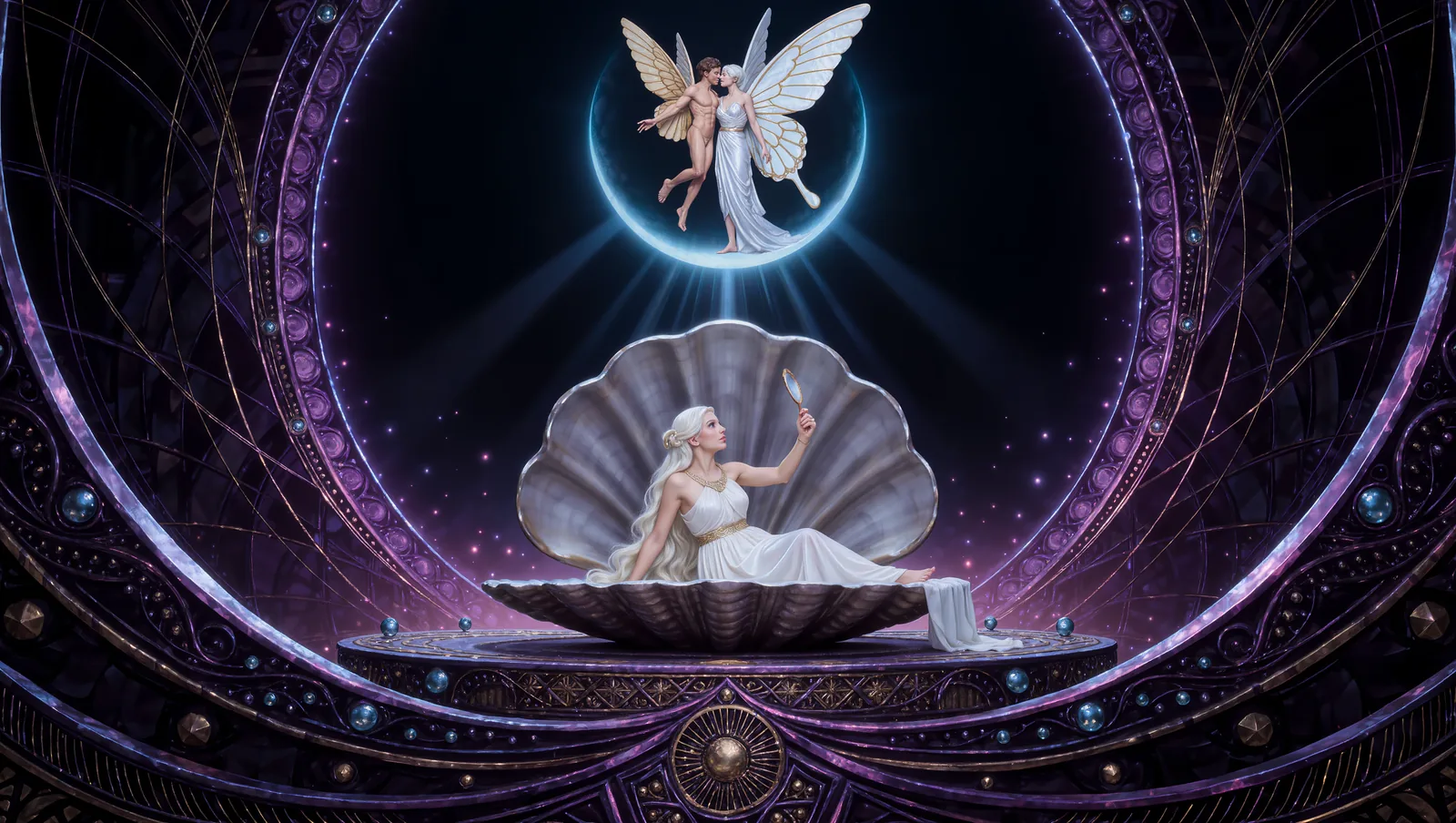
They were the same pattern, expressed in two different times.
Her trials in stone and starlight,
his trials in pixels and concrete.
Her lamp and his microphone.
Her underworld and his chat.
Her box of sleep and his temptation to disappear.
Two iterations of one soul-trajectory, circling the same mountain, generation after generation.
“Why?” he asked, raw. “Why keep doing this? Why send us back again and again?”
Her expression shifted, a shadow of something like grief passing through it.
“Because the world keeps forgetting,” she said, “and we keep agreeing to remember.”
He stared at her.
At himself.
At them.
At the shimmering place where their identities overlapped.
For a wild, vertiginous moment, he felt it:
Not “I was literally that girl in a past life,”
not anything simple enough to fit on a TikTok astrology meme—
but that he was part of a lineage of Psyches:
Souls who take on the job of walking into the dark for love,
of being broken open until they can carry others,
of repeatedly trusting something they cannot see.
He felt pride and terror in equal measure.
It was one thing to joke about being “the cult leader of broken toys.”
It was another to understand that his life was part of a much older agreement.
The Awakening
The note thrummed inside his bones, louder now.
Identity.
Source.
Wound.
Three pillars.
He could feel how they connected:
He was not his roles.
He was a repeating pattern.
That pattern was held, always, by something larger than him.
And the pain he’d carried was not a random tax—it was the exact currency his work required.
This was not a vision stapled on from the outside.
This was his own understanding, waking up.
He realized, with a strange, quiet shock, that no one could give this to him and no one could take it away.
Not critics.
Not fans.
Not gods.
“What… is this?” he asked hoarsely.
She reached out.
Her palm pressed against the inside of the mirror.
He knew what she was going to say before she spoke.
“You asked,” she reminded him. “You wanted to know what Psyche is to you.”
He nodded, unable to speak.
“This is the first awakening,” she said. “Not of me. Of us.”
There was a difference in that plural that rearranged something inside him.
Not goddess dispensing wisdom to mortal.
Not myth lecturing man.
But soul recognizing itself across the gap.
“You will forget this,” she added softly. “On some days. In some rooms. You will talk yourself down, shrink, hide. That’s fine.”
He almost laughed.
Of course he would.
“But you won’t be able to pretend you never saw it,” she finished. “And that is what changes everything.”
The mirrors brightened, then dimmed.
Her face blurred.
His knees buckled again—
but this time, he fell up.
Return
He woke in his chair with his heart pounding and his shirt damp with sweat.
The monitor was still dark.
The room still the same cheap little womb of wires and clutter.
But he felt like somebody had rearranged the furniture inside his skull.
He sat there, breathing hard, rubbing a palm over his sternum as if some physical imprint might be there.
Identity.
Source.
Wound.
He didn’t have language tidy enough for what had just happened.
He only knew this:
When he thought of himself as “the guy with a show,”
it felt laughably small now.
He was still that.
But also something older.
Something that had agreed to this job long before usernames and overlays existed.
He stood slowly, legs trembling.
Lanore appeared from wherever she’d been hiding and wound herself around his ankles, purring loud enough to rattle bone.
“Yeah, yeah,” he whispered, bending to scoop her up. “I know. Feed the priest.”
He carried her to the kitchen, mind buzzing and strangely calm at the same time.
The encounter might fade in sensory detail.
His brain would try to edit it, rationalize it, tuck it into “weird dream” if he let it.
But underneath that mental noise, something had settled into place:
A new center of gravity.
The first awakening of the Two Psyches was not about seeing a ghost in a mirror, or talking to a myth like a character.
It was the moment he understood, viscerally, that he was:
The wearer, not the masks.
Held, not random.
Shaped, not ruined, by what broke him.
The rest of Part Three would ask him to live as if that were true.
For now, it was enough that he had seen it once,
clearly,
with nowhere to hide.
The room had remembered him.
And he, finally, had begun to remember himself.