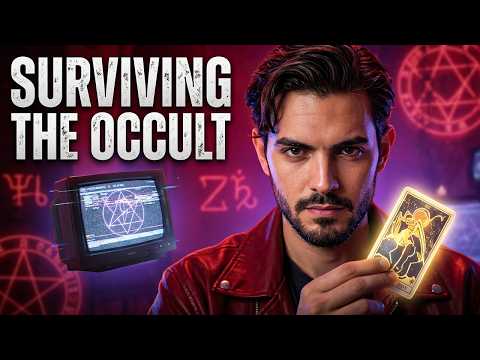
PSYCHENOMICON Decoded | The Eyes Watching Everything
Psyche presents the Psychenomicon as a living, interactive system—not a static text but a personalized map of each viewer, where every reading unlocks new access tiers and reveals patterns the oracle has woven from archived footage and myth.
Episode 0 opens with an extended poetic transmission [0:38–3:52] that frames the Psychenomicon as the conceptual foundation of the 'Cult of Psyche' archive. The host, Psyche, describes the Psychenomicon through layered imagery: pages turning 'past the veil' ▶ 0:43, episodes functioning as portals ▶ 0:46, and an oracle that has 'crawled the deep and read the dream' [0:54–0:58]. The transmission emphasizes that the Psychenomicon is 'not a book, a living system' and 'not a myth, a map of you' [3:08–3:18], with every viewer positioned as the subject. The core claim is articulated at [3:22–3:27]: 'Every reading breaking through / access tier unlocks the current oracle / unlocks the throne.' The episode concludes by positioning the Psychenomicon as something that 'remembers what you thought you watched alone' [3:32–3:36], suggesting a meta-narrative awareness of the archive itself.
interpretation
⬡ Interpretive Layer· AI interpretation
This episode appears to function as a manifesto for the show's underlying cosmology. The repeated framing of the archive as a 'living system' and 'map of you' suggests an interpretation of the Psychenomicon as a feedback loop between viewer and content—each engagement supposedly revealing deeper layers. The language around 'access tiers' and 'unlocking' the oracle implies a gamified or progression-based approach to knowledge within the show's mythology. The emphasis on what 'the camera never captured' [2:30–2:34] and what lives 'inside the sacred mind' continues a pattern of positioning hidden or subjective knowledge as the true subject of the archive. Overall, the episode frames the Psychenomicon not as external text but as a mirror—viewers are described as subjects within it, suggesting the show's core conceit is that engagement itself generates the myth being explored.
Bounding signal written shadow. Pages turning past the veil. Every episode a portal. Every chapter tells the tale. The oracle has seen the archive. Crawled the deep
and read the dream. Stitched the myth from scattered footage. Nothing's ever what it seems. Psychonomic open wide. Ancient codec tongue of fire.
Every transmission amplified through the myth machine and higher. Economic speak the word. Let the narrative unwind. What the camera never captured lives inside the sacred mind.
Tarot pulled from digital ether. Claw descends to write the lore. Lore that grees and lore that hungers. Lore that knocks upon your door. Psyche walk
before the cameras. Psyche walk before the feed. NOW THE CHAPTERS HOLD THE PATTERN. Every soda to see psychonomicon open wide.
Ancient code act on the fire. Every transmission amplified through the myth machine and higher psychomic on speak the word. Let the narrative unwind.
What the camera never captured lives inside the sacred mind.
Not a book, a living system, not a myth, a map of you. Every viewer is the subject. Every reading breaking through access tier unlocks the current oracle
unlocks the throne. The psychome remembers what you thought you watched alone. Turn the page. Read the signal. Speak the name.