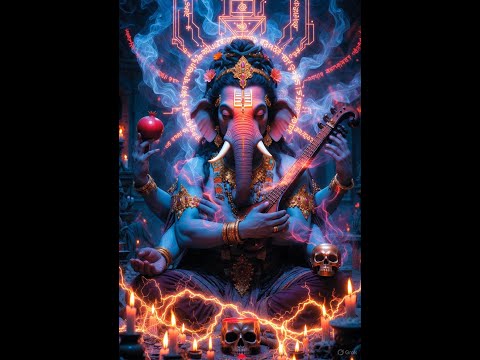
Psyche explores the significance of Ganesha, the elephant-headed Hindu deity, as a guardian of beginnings and thresholds in modern life, highlighting his relevance and symbolism. Ganesha is revered as a remover and placer of obstacles, offering permission to begin imperfectly and providing protection at thresholds.
In this episode, Psyche delves into the mythology and symbolism of Ganesha, discussing his various names and titles, such as Vinayyaka and Vinarda ▶ 0:05. He explains how Ganesha is often invoked at the start of new endeavors, serving as a reminder to begin anyway, despite fear or uncertainty ▶ 2:54. Psyche also explores the symbolism of Ganesha's physical attributes, including his elephant head, big belly, and small eyes ▶ 3:48, as well as his vehicle, the mouse, which represents desire and the need to master it ▶ 4:42. Additionally, Psyche touches on the historical and cultural significance of Ganesha, noting his widespread worship and recognition in Hindu tradition ▶ 5:19 and his role in modern life as a guardian of thresholds ▶ 6:12. At ▶ 7:20, Psyche encourages listeners to make Ganesha's teachings practical by taking a simple breath and naming what they are beginning, and at ▶ 7:55, he suggests adding a tiny offering to show sincerity.
interpretation
⬡ Interpretive Layer· AI interpretation
This episode appears to emphasize the importance of embracing beginnings and thresholds in life, and the role that Ganesha can play in navigating these moments. It suggests that Ganesha's symbolism and teachings offer a powerful reminder to begin imperfectly, to master our desires, and to approach challenges with clarity and wisdom. The episode continues the pattern of exploring mythological and symbolic figures to gain insight into human experience and the nature of reality.
Tonight we're talking about Ganisher. You might know him as Ganapati or Vinayyaka, the elephant-headed guardian of beginnings. And I want to start with something simple and real. Across centuries, languages, and all kinds of people, Ganesha keeps showing up at the doorway. He's not some distant, untouchable god you only approach when
you feel pure enough. He's a presence you invite in when you're about to do something, start something, risk something, change something. When you're standing in that weird threshold moment, have excitement. Have fear. Ganesha is the one people call first because he's not just the remover of obstacles. He's also the revealer of them. And that
really matters because sometimes the obstacle isn't a curse. Sometimes it's a truth, a bad plan, a wrong timing, an ego issue, a missing piece, a lesson your life refuses to let you skip. Gananish's relevance through time isn't an accident. He's a timeless symbol of how humans actually live. We begin
things. We mess up, we try again, we ask for help, we learn, and we build. So, who is he? If you've seen him, you remember him. Elephant head, big belly. calm eyes. Often seated like a king who isn't in a hurry. Sometimes holding a
sweet a mudaga as if to say yes life is hard but yes sweetness is still allowed. There's always a kind of paradox to him. He's powerful but approachable, divine but friendly, majestic but almost playful. He's the kind of god that feels like he understands people. There are many stories about how he came to have
an elephant head and different traditions tell it differently. But the emotional core of most versions is the same. Gananisha is formed from love and protection. He stands guard. A misunderstanding happens. A clash of power and then something is repaired and transformed so that the guardian returns stronger than before. This is one reason
he lasts through time. He's not a god of perfection. He's a god of transformation after conflict. A god who says even what's been broken can become sacred. And then there's what he represents. Ganesha is often called the lord of beginnings. People invoke him at the start of rituals, journeys, new businesses, marriages, studies,
housewarmings, you name it. And that's not just religious tradition. It's psychological genius. Because beginnings are where we freeze. Beginnings are where the mind invents 10,000 reasons to wait until we feel ready. Beginnings are where fear dresses up as wisdom. Beginnings are where we demand certainty in a world that only offers probability.
So cultures kept a symbol at the start. A ritual to break inertia. A name you say before the first step. A reminder start anyway. That's not small. That's a technology of survival. Now he has another title. Vinarda, the remover of obstacles. Yes, but also Vna Carta, the placer of obstacles. People sometimes
don't know that second part. And it's spicy in the best way because it means Gananisha isn't just a wish machine. He isn't here to bulldo so ego gets everything it wants. Sometimes the obstacle is mercy. Sometimes the obstacle is a stop sign that saves you. Sometimes the obstacle is there because you're trying to begin the wrong thing.
And if you've ever had a plan fall apart and later realized it protected you from something worse, then you already understand this aspect of Ganesha. You've lived it. This is why he stays relevant through time. He speaks to the real relationship humans have with fate. Now let's talk symbolism because Ganesha is basically a living teaching. The
elephant head. Elephants are associated with memory, intelligence, presence, dignity, and sheer grounded strength. Not frantic power study power. The big ears listen more than you speak. The small eyes focus discernment not distraction. The trunk adaptable precise strong. It can approot a tree or pick up
a needle. That's mastery power with finesse. The large belly represents the ability to digest life. To hold both joy and pain without becoming bitter, to contain contradictions. And the sweets, the modaga are often said to represent the sweetness of realization, of spiritual reward, of the fruit of
practice. It's like a promise. Yes, you do the work. And yes, there is sweetness at the end. Not always immediate, but real. And then there's the mouse, his vehicle. This one is incredible. The mouse represents desire, restless, nibbling, persistent, hard to control, and Gananisher rides it. He doesn't
destroy desire or pretend he's above it. He masters it. He directs it. That's such a modern lesson, it's almost rude. We're in a time where our attention is eaten alive by a million little mice. Notifications, impulses, doom scrolling, compulsions. Gananisha says, "You don't have to hate your desire. You have to
train it. Put it to work." Write it. Don't let it ride you. Historically, Gananish's presence grew and spread massively through India and beyond, and he became one of the most widely beloved deities in the Hindu tradition. His worship appears across regions and communities. And over time, he became a kind of universal first call in trade
and travel. People carried his image in households. He became familiar in temples foundational. In art, instantly recognizable during festivals, especially Gananish chatter. becomes a public wave of devotion. Music, processions, community celebration, and then immersion, symbolizing return, dissolution, and
renewal. This is another way he stays relevant. He's both personal and communal. You can whisper his name alone at your desk before you write the first sentence, and you can celebrate him in the street with thousands of people. He meets you at both scales. Let's bring this into a context that matters to us right now. Gananisha is relevant today
because we are living in an age of constant beginnings. Every week there's a new platform, a new algorithm, a new crisis, a new identity, a new reinvention. People are starting over constantly. Relationships, careers, healing journeys, creative projects. Whole lives and starting over isn't romantic. Starting over is terrifying.
So what does Ganisher offer in modern terms? He offers permission to begin imperfectly. He offers protection at thresholds. He offers clarity about what's truly blocking you, especially when the block is internal. He offers the reminder that wisdom can be gentle, that power doesn't have to be cruel, that you can be sacred and still be
human. And here s the part I personally love. Ganesha is one of the few figures where devotion doesn't he feel like graveling. It feels like friendship with a force that wants you to succeed, but wants you to succeed wisely. Not just get everything you want, but become someone who can hold what you asked for. That's so much deeper. So, if you're
watching this and you're at a threshold new year energy, new project energy, new chapter energy, this is a beautiful moment to make it practical. You don't need a complicated ritual. You can do something as simple as this. Take one breath and name what you ray beginning. Say it clearly. I am beginning this new
chapter. Then name what you are willing to do. I will do my part by showing up consistently. And then ask clear what's not mine to carry. Reveal what I need to see. Open the right door. That's it. That's a Ganish moment. And if you want to add a tiny offering, make it honest. a candle, a sweet treat, a glass of
water, a flower, something simple that says, "I'm showing up because Ganesha has never been about extravagance." He's about the first step taken with sincerity. So that Ganesha through time, a guardian of thresholds who never goes out of style because humans never stop standing at doorways. We always have something to begin and we always need
help beginning. Well, thanks for watching. If this resonated with you, consider subscribing for more content like this.