// transmission
Psyche explores the 12th story from the Baital Pachchisi mythology, 'The Cup That Held Four Innocences', discussing the human need for blame and the dangers of false accusation. He analyzes the story of a pilgrim's death and the four potential suspects, concluding that none of them are guilty.
Baital Pachchisi TalesHave you ever noticed how when something
Have you ever noticed how when something
goes wrong, our first instinct is to
find someone to blame? It's like a
reflex. A fire starts, a project fails,
a relationship ends, and our minds
immediately start scanning for a
villain. It feels better, doesn't it, to
have a target for our anger, a neat
little box to put the problem in. But
what if there is no villain? What if the
real enemy is just chaos? There's an
ancient Indian story that explores this
very idea and it's a brilliant trap for
the mind. It's called the cup that held
for innocences and it goes like this.
There was a young brilliant man named
Haraswami deeply in love with his
beautiful wife. One hot summer night
they were sleeping on the roof of their
house when a migot flying through the
sky saw the wife's face struck by a
sudden desire. He swooped down, lifted
her sleeping body and vanished into the
night. When Har Swami woke up, his wife
was gone. The space beside him was just
an empty, insulting void. He searched
the house, the streets, the entire city,
but found nothing. The grief was so
absolute, so devastating that it
completely broke him. Laugh when it
turns feral can make you do extreme
things. He renounced his entire life. He
smeared his body with ash. put on the
simple robes of a pilgrim and began to
wander the earth. A man basically
walking around like an open wound. He
traveled from town to town. His grief
and hunger his only companions. One day
absolutely starving. He arrived in a new
village. He made a small cup out of
leaves and went to a local Brahman's
house to beg for food. The Brahman
wanting to perform an act of charity
took the leaf cup, filled it with rice
and milk and gave it to him. The pilgrim
took the food to a large banyan tree by
a pond. He set the cup down at the base
of the tree and went to wash his hands
and face before eating. And in that
moment, the world did what the world
sometimes does. It introduced a small
ordinary horror. A black snake slithered
out from the roots of the tree. It
dipped its fangs into the cup of rice
and milk, poisoning the food, and then
slipped away unseen. The pilgrim
returned. His hunger was screaming so
loudly it drowned out any sense of
caution. He didn't notice anything
wrong. He quickly ate the food but
pausing took effect almost immediately.
Staggering back to the Brahman's house,
he collapsed gasping. You have given me
poison and I am dying. And then he died
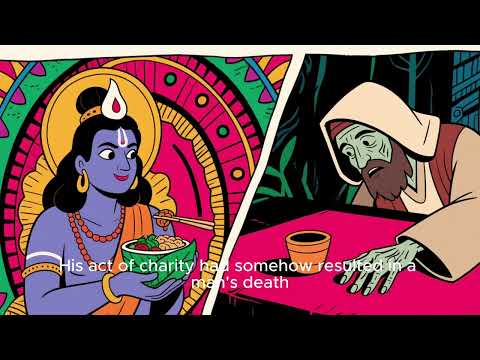
right there on the doorstep. But Brahman
seeing the dead man panicked. His act of
charity had somehow resulted in a man's
death. In his fear and rage, he did what
so many of us do. He turned on the
nearest, most convenient target. He
dragged his own wife out of the house,
threw her into the street, and screamed,
"Get out, you murderer of a Brahman."
So, here's the puzzle the story
presents. A man is dead. Who is guilty?
Think about it. We have four potential
suspects. Let's break them down. First,
the snake. Who's the snake guilty? Well,
a snake's mouth contains venom. That's
its nature. The snake doesn't have a
moral code. It just has a biological
function. To blame the snake is like
blaming a storm for being wet or fire
for being hot. It's just what it is.
It's an agent of nature, not an agent of
malice. So, the snake is not guilty.
Okay. What about the Brahman who gave
the food? His intention was pure. He was
performing a charitable act, giving food
to a hungry man. He had no idea the food
would become poisonant. He was part of
the chain of events that led to the
death. But can we say he is morally
culpable? These story says no. Being a
cause is not the same as being guilty.
He is innocent. What about the Brahman's
wife? This is where it gets interesting.
She's the one who gets punished. But
what did she actually do? She simply
followed her husband's instructions,
likely preparing or handing over the
food. She is the classic scapegoat. When
tragedy strikes and we can't find a
clear villain, we often lash out at the
most convenient or powerless person
available. It gives us a false sense of
control in a chaotic situation, but in
reality, she is completely blameless.
That leaves our final suspect, the
pilgrim himself. Could he be at fault?
He's the one who ate the poison food,
but he ate it unwittingly. If you look
deeper, his entire state of being was
the real poison. He was living in raw,
unprocessed grief, so consumed by his
loss that he wasn't paying attention.
His hunger made him rush and his rush
made him not notice the subtle signs of
danger. But is that guilt or is that
just profound vulnerability? The story
argues it's the latter. He is a victim
of his circumstances, not a perpetrator.
So if the snake isn't guilty, the
Brahman isn't guilty, his wife isn't
guilty, and the pilgrim isn't guilty.
Who is? The answer the story gives is
radical. No one. The guilt of killing
the pilgrim attaches to none of them.
The real takeaway from the story isn't
about solving a murder mystery. It's a
profound lesson about the human need for
blame. It's a warning against the sin of
false accusation. When we can't find a
clear person to blame, we get
uncomfortable. That feeling of
unresolved injustice, of pure random
tragedy, is terrifying. So, we invent a
villain. We point fingers. We sacrifice
the innocent just to feel a little more
certain, a little more in control. The
story says, "Stop. Slow down before you
accuse. Trace the intent. Trace the
knowledge. Trace the agency. And if you
can't find clear evidence of any of
those things, then you must accept the
difficult truth. Sometimes terrible
things just happen. Sometimes the only
villain is chaos itself. Resisting the
urge to falsely blame someone isn't a
sign of weakness. It's a sign of
profound wisdom and moral strength. It's
about keeping your own hands clean when
everyone else is looking for someone to
stone. This story is thousands of years
old, but it feels like it could have
been written yesterday. In our own
lives, in our communities, online drama
erupts, things go wrong, and the
pointing begins immediately. This
ancient tale reminds us to take a
breath, to resist the easy, satisfying
path of blame, and instead embrace the
more difficult, but ultimately more
truthful path of understanding. Because
sometimes the most courageous thing you
can do in the face of tragedy is to
admit that you don have all the answers.
Thanks for watching. If you found this
interesting, think about subscribing for
more stories that make you think. See
you next time.
you next time.
↑↓ navigate · Enter seek · Click to select
/// initiate_layer
Observers see the surface.
/// within ∞ The Current
Browse era →