// transmission
The episode explores the 13th story from the Baital Pachisi, a collection of Hindu folktales, which centers on a king who disguises himself as a thief. The story serves as a mirror reflecting the hidden parts of ourselves and offers lessons on the importance of wisdom and self-reflection.
Baital Pachchisi TalesHave you ever wondered why we sometimes
Have you ever wondered why we sometimes
make choices that seem completely out of
character? Why a good person might lie?
Or why someone smart might fall for a
completely wrong person? Today, we're
diving into an ancient story that
unpacks this very human mystery. It's a
tale about a king, a thief, a demon, and
a woman who fell in love with a
beautiful disaster. This isn't just a
fairy tale. It's a mirror reflecting the
hidden parts of ourselves. The story is
called the king who wore a thief's mask.
It begins in a city plagued by nightly
thefts. The merchants are desperate and
their king ran here promises to solve
the problem. He sets guards, issues
strict orders, but nothing works. The
robberies continue. Frustrated, the king
decides to take matters into his own
hands. One night, he sheds his royal
robes, takes up a sword, and walks the
streets alone, disguised as an ordinary
man. Soon, he spots a figure moving with
the telltale silence of a thief. The
king confronts him, "Who are you?" The
man replies without hesitation, "I am a
thief. Who are you?" And here the king
makes a fateful decision. Instead of
revealing his authority, he lies. I am a
thief also. This is the first and most
important mistake. The moment the king
puts on the thief's mask, he stops being
the solution. Nan starts becoming part
of the problem. He enters the thief's
world on the thief's terms. Delighted to
find a partner, the real thief invites
the king to join him. Together, they
loot several houses. Then, the thief
leads the king to a hidden well on the
outskirts of the city. They descend into
a secret passage, a corridor leading to
a subterranean world, a city beneath a
city. Down there, the thief casually
stations the king at a gate, treating
him like a common lookout and disappears
with the stolen goats. The king, who
thought he was in control, has just been
played like a pawn. This is our first
major lesson. When you impersonate
corruption, even to understand it, you
don't stay clean. You start breathing
its air. The disguise begins to stain
your soul. The king thought he was being
clever, but by wearing a thief skin, he
handed over his power. While the king
waits at the gate, a servant woman
recognizes him. "Your majesty," she
whispers. "Terrify!
whispers. "Terrify!
This is no place for you. Leave before
he returns."
he returns."
She shows him the way out, and the king
flees back to his palace, escaping the
consequences of his own disguise. The
next day, King Rantier returns, but this
time with his army. He follows the same
path down and into the underworld city
to capture the thief. But the thief is
smart. He escapes and runs to the ruler
of this underground domain, a powerful
demon lord. The thief says, "A king from
the world above has come for me. Protect
me or I'll take my business elsewhere."
The demon lord, who has been profiting
from the thief's activities, agrees. He
unleashes his terrifying power on the
king's soldiers, causing chaos and
panic. The king immediately understands
that this is a battle he cannot win with
ordinary strength. He has to retreat. As
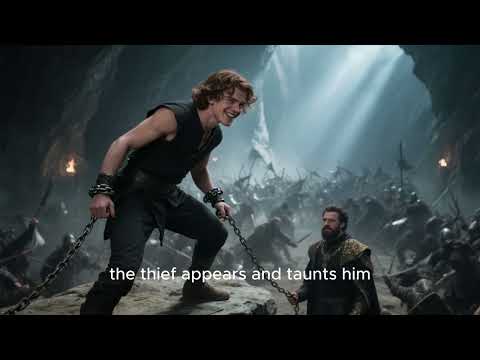
he flees, the thief appears and taunts
him. Are you a true warrior? And yet you
run from the fight. The words sting the
king's cry. He stops, turns, and faces
the thief one-on-one. This time, without
masks or tricks, the king's true
strength prevails. He defeats and
captures the thief. This brings us to
our second lesson. Force without wisdom
creates bigger problems. The king's
initial tough on crime approach didn't
work. It just made the thief escalate
his game. Calling on his powerful ally,
the demon. This demon lord is a powerful
metaphor for the hidden consequences of
our actions. It represents the
destructive forces we empower when we
feed them. Whether it's addiction,
drama, or chaos in our communities. You
can't fight a demon with simple force.
You have to stop feeding it. Now, the
story takes another fascinating turn.
The king parades the captured thief
through the city. He wants everyone to
witness that justice is being served. As
the procession passes the house of a
wealthy merchant, the merchant's
daughter, Sha Pani, hears the commotion.
She looks out and sees the thief. He's
handsome, defined, and even in chains,
he carries himself with an unbreakable
confidence. And in that single moment,
she falls completely and utterly in love
with this image of a beautiful rebel.
This isn't a slow, developing affection.
It's a sudden consuming fixation.
She rushes to her father and demands,
"Go to the king and have that man free.
I don't care what it costs." Her father
is horrified. "He's the one who has
terrorized our city." But Sha Hani is
unshakable. If you return without him,
she declares, I will not survive it.
This part of the story is a powerful
warning about projection. Shiaani
doesn't love the thief. She loves the
idea of him. She's fallen for an
archetype. the romantic outlaw, the
handsome man condemned by fate. She's
not seeing the real person who caused so
much harm. She's seeing a character in a
drama she wants to star in. The story is
telling us to be careful what we call
love. Sometimes it's just our own
fantasy projected onto someone else. Her
father goes to the king and offers a
fortune for the thief's release, but the
king refuses. The damage done is too
great. The thief must face justice. When
the merchant returns with the bad news,
Shiahani is devastated. Meanwhile, the
thief in his cell hears about Shaani's
passionate demand and her willingness to
sacrifice everything for him. And his
reaction is profound.
First, he laughs out loud. Then, he
weeps bitterly. Why this strange mix of
emotions? This is the very heart of the
tale. The king in the story explains it
perfectly. The thief weeps because he is
crushed by the weight of her devotion.
He thinks she is willing to give
everything for me. A worthless thief.
What could I possibly give in return? He
feels the terrifying debt of a love he
knows he doesn't deserve. And that
feeling of unworthiness is often what
makes people sabotage the best things in
their lives. And why does he laugh? He
laughs at the sheer wild absurdity of
fate. He sees the chaos of the universe
in a single moment that a brilliant
noble girl can be captured by love for a
man on the edge of ruin. That blessings
often fall on the undeserving like rain
on a barren mountain. He's laughing
because the world doesn't operate on our
ideas of fairness. It's a storm and
lightning strikes where it will. The
thief is executed, but Shabhani rushes
to the site ready to end her own life in
a final act of devotion. At that moment,
a goddess appears from a nearby temple,
moved by the sheer force of Shabani's
will. I am pleased with your resolve,
the goddess says. Ask for a boon.
Shabani's request is simple. Bring him
back to life. The goddess grants her
wish and the thief is resurrected. It's
crucial to notice that the goddess
rewards Shaani's willpower, not her
wisdom. She praises her courage, not her
judgment. This teaches us that spiritual
power or the universe itself often
responds to intensity. It will answer
the strength of your vow even if that
vow is aimed at the wrong target. This
is why it's so important to aim
carefully in life to be sure that what
we desire so intensely is actually good
for us. So what does this ancient story
leave us with? It leaves us with a map
of our own hidden psychology. A king who
wears a thief's mask gets pulled into
the thief's world. A society that only
treats symptoms instead of root causes
will see problems return often in a more
monstrous form. A person who falls in
love with an image risks everything for
a fantasy. And a man struck by a love he
feels he doesn't deserve laughs at the
madness of fate and weeps at the cost of
grace. This story asks us to look at the
masks we wear, the forces we feat, and
the fantasies we fall for. It reminds us
that true strength isn't about disguise
or brute force, but about wisdom,
discernment, and facing reality as it
is, not as we wish it to be. Thank you
so much for joining me on this journey
into myth and meaning. If this story
resonated with you, let me know your
thoughts in the comments, and don't
forget to like and subscribe for more
tales that teach us about ourselves. See
you next time.
you next time.
↑↓ navigate · Enter seek · Click to select
/// initiate_layer
Observers see the surface.
/// within ∞ The Current
Browse era →