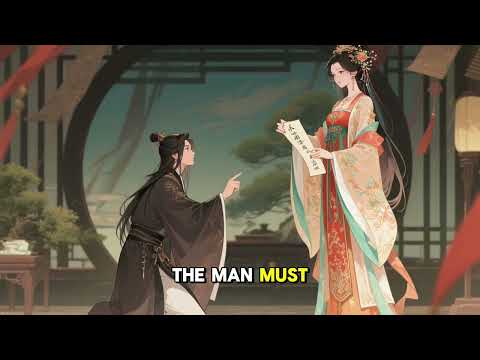
Psyche explores the ancient tale of magic pills and mistaken identities, where a young man uses mystical transformations to secretly marry a princess, leading to a complex legal and moral riddle about truth and ownership.
The episode begins with Psyche introducing the story of a young Brahman named Mansvi who falls in love with a princess named Shandra Prabe after seeing her in a garden ▶ 0:29. With the help of two occultists, Shashi and Moldiva, Mansvi uses magic pills to transform into a woman and gain access to the princess ▶ 1:41. The princess and Mansvi form a secret bond, and they get married by mutual consent ▶ 2:59. However, their secret is eventually discovered, and the king is pressured to give the princess to another man ▶ 3:49. Mansvi uses the magic pills again to form a second secret union with the minister's son's wife, Sabahhigisendark ▶ 4:39. The story takes a turn as Mansvi and his companions devise a new plan to resolve the complex situation ▶ 5:00. Key events in the story include the initial meeting between Mansvi and the princess ▶ 0:36, the creation of the magic pills ▶ 1:44, and the formation of the two secret unions [2:59, 4:41].
interpretation
⬡ Interpretive Layer· AI interpretation
The story appears to explore themes of love, identity, and the consequences of playing with forces beyond one's control. The use of magic pills as a plot device suggests that the story is also about the power of transformation and the blurring of boundaries. The complexities of the characters' situations and the web of secrets and lies that they create continue the pattern of exploring complex moral and philosophical questions.
Have you ever heard a story so tangled it feels like a dream and a legal puzzle all at once? Today, we're diving into an ancient tale that's about so much more than meets the eye. It's a story of magic pills, mistaken identities, and a king forced to answer an impossible question. It all begins in the city of
Kavati with a princess named Shandra Prabe, whose name means moonradian. One day, she wanders into her palace garden. But destiny has other plans. A handsome young Brahman named Mansvi has accidentally strayed into the same garden and fallen asleep under a tree. As the princess approaches, he wakes.
Their eyes meet and in that single moment the world shifts. It's not just attraction, it's a force of nature. Mansvy collapses, completely overwhelmed. The princess trembles as if her soul has been knocked loose. Her companions catch her and rush her back to her chambers. Her mind captured by the image of a man whose name she doesn't even know. Meanwhile, two men
trained in the occult sciences, Shashi and Molddeva, happen upon the unconscious mansv. Shashi immediately understands what's happened. A maiden has shot arrows from her eyes. He says, "This is Love's force." Moldiva, wanting to help, wakes Mansvie with a splash of water. When asked what happened,
Mansvy's reply is laced with despair. Why tell grief to someone who can tea remove it? But Muldiva insists he can help. So Mansvy confesses he saw the princess and now if he can't have her, his life is over. Moldiva, a man who sees reality as something you can edit, agrees to help. This is where the real
magic begins. Moldiva creates two mystical pills. He gives one to Mansvi and says, "Place this in your mouth and you will become a young woman. Remove it and you'll be yourself again." Mansv obeys and his form instantly changes. Moldiva takes the second pill, transforming himself into an old man. Together, they go to the king's court.
Muliva presents a masterful lie. He explains he is a traveler who lost his family and needs someone to guard his daughter-in-law until he returns. The king fearing a Brahman-esque curse if he refuses. But seeing the risk in accepting such a beautiful young woman finds himself trapped. He reluctantly agrees and commands his own daughter, Princess Chandrabb, to take this
stranger into her private chambers and never let her out of her sight. That very night, alone with the disguised Mansvi, the princess confesses her own mysterious illness, how she saw a stranger in the garden, and has a been able to eat, sleep, or think of anything else since. The daughter-in-law then asks a fateful question. What will you give me if I reunite you with him? The
princess promises her very life. With that, Mansv removes the pill from his mouth. The disguise falls away. The man from the garden stands before her. In the secrecy of the royal chamber, they form a bond of their own. A marriage by mutual consent, hidden from the world. For 6 months, their secret life continues. A woman by day, a man by
night, and soon the princess is expecting a child. But secrets involving royalty rarely stay secret for long. The king attends a wedding at his minister's house, bringing his family, including the disguised Mansvie. There the minister's son sees the beautiful Brahman girl and falls instantly obsessively in love. He declares he will
die if he can't have her. The news travels up the chain of command and soon the minister is begging the king to give him the girl to save his son's life. The king is furious. The king does not give away what was entrusted to him. He roars, but his advisers pressure him, warning of political chaos if the minister's son
dies. They argue that stability is more important than a promise to a long-gone traveler. Trapped again, the king caves. He orders the daughter-in-law to go to the minister's son. She negotiates a condition. The man must obey her every command. She then declares he must first go on a series of holy pilgrimages before she will accept him. The lover
struck son agrees, but only after she moves into his house. So, she goes. The minister's son instructs his own wife, a woman named Sabahhigisendark, to live peacefully with the newcomer and then he departs on his journey. It's from that night alone with the disguised Mansvi. The wife confesses her own deep loneliness and once again Mansvi asks
that familiar question, what will you give me if I help you? She promises lifelong devotion. So Mansvi removes the pill, reveals his true form, and a second secret union is formed. Six more months pass. The minister's son is due to return. Realizing the trap is closing, Mansvi slips out of the house in his male form and flees back to
Moldeva, the occultist. He tells him everything. Hearing the chaotic tale, Molddeva and his companion Shashé devise a new plan. They use the magic pills to disguise themselves as an old man and a young one, and they return to the king's court. Muliva, playing the role of the original Brahman, furiously demands his daughter-in-law back. The king
shamefully explains what happened. Muldiva fains rage, threatens a world-ending curse, and then offers the king a way out. To avoid my curse, you must give your daughter, the princess, in marriage to my son. Desperate, the king agrees. A grand public ceremony is held. The princess, Chandra Prab, is
officially married to Shashi, who is disguised as the young Brmond's son. Just as they are leaving with the princess and her dowy, Mansvby arrives consumed by rage. Give me my wife, he shouts at Shashi. Shashi calmly replies. I married her before 10 witnesses. She is mine. Mansvby fires back. She carries my child. How can she be yours? The
argument escalates a storm of private love versus public law. And this is the exact moment the vetrilla, the spirit telling this story, pauses and asks King Vikram the ultimate question. Tell me, oh king, whose wife was she? King Vikram, bound to answer, declares, she became Shashi's wife. The spirit, surprised, challenges him, but she
carries Manswre's child. How can she belong to Shashi? Vikram s answer cuts through the emotion and lays bare the cold logic of the world. No one knew of the child. The affair with Mansvi was a secret, but Shashi married her publicly, before witnesses, and with the king's blessing. Therefore, in the eyes of the law and society, she is his wife. And
with that legally sound but emotionally devastating answer, the tale ends. But what does it all really mean? This story isn't just a fantasy romance or a legal riddle. It's a profound commentary on power, desire, and how we define truth. First, notice how love is portrayed not as a choice, but as a kind of
possession. People see someone collapse and then demand that person as a cure for their suffering. It's not love as connection, but love as compulsion. Second, the magic pill is a brilliant symbol for how identity can be used as a tool for access. It allows Mansvy to bypass every social, political, and domestic wall. His double life, woman by
day, man by night, perfectly represents the gap between our public roles and our private realities. Third, look at the king. He knows what's right. He says a king must not betray a trust. But when faced with political pressure, he chooses what's convenient, not what's correct. The story is brutally honest about how our
institutions often prioritize stability over integrity. And finally, the riddle itself reveals the story's deepest theme, how truth is decided. Is the truth biological based on who the father of the child is? Is it emotional based on who the princess loves? or is it contractual based on a public ceremony
with witnesses? King Vikram's answer tells us that for better or worse, society is governed by what can be proven, not always by what actually happened. The public record, the witnessed contract, overrides the secret truth of the heart. It's a chilling lesson, but one that resonates even today. This ancient tale reminds us that
stories are often masks, and underneath them lie the timeless, tangled truths of human nature. Thanks for joining me on this deep dive. If you enjoyed unraveling this ancient puzzle, be sure to like, subscribe, and hit that notification bell for more stories that make you think. See you next time.