◈ What Happened
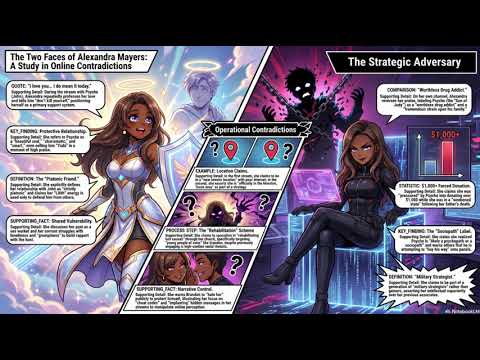
The episode presents a detailed case study of Alexandra Mayers (also known as Alex or Melissa), a streamer who operates under a carefully constructed public persona. At ▶ 0:47, the hosts introduce their analytical framework: examining the 'massive delta' between how someone presents themselves online versus their actual behavior. Alexandra's primary broadcast, 'IRL News Time Live,' establishes her authority through a deliberate 1940s radio announcer voice and claims of broadcasting from a remote location [2:37-3:10]. She frames herself as a church-affiliated rehabilitator of 'lost causes,' specifically young people of color, pointing to a younger community member named Brandon as her current project [3:54-4:08].
The hosts identify a critical contradiction between her stated boundaries and actual conduct. On her broadcast, Alexandra insists that anyone she helps 'cannot have romantic attachment' to her [5:13-5:16]. However, when examined through transcripts from 'Psyche's Nightmares' (hosted by John, who also uses the alias Psyche), she displays possessive behavior toward him, telling him 'You're my eternal Jon forever' and stating 'I'm going to take over the cult' [5:33-5:50]. When Psyche goes missing from stream for a day, she berates him and delivers what the hosts characterize as an unsettling threat: 'I swear to God, I'll kill you before you kill yourself' [6:03-6:10].
The analysis then shifts to Alexandra's treatment of Psyche on her own broadcast, where she launches what the hosts describe as a character assassination campaign. She refuses to use his name, instead referring to him exclusively as 'the son of Judy Bates,' engaging in what they identify as dehumanization [7:57-8:20]. She publicly diagnoses him with various ailments, compares his physical appearance to Eugenia Cooney, and claims he is 'aging rapidly,' stating 'Every day for you is essentially a month' [8:35-8:48]. Most seriously, she accuses him of what she calls 'PDF proclivities,' heavily insinuating pedophilia and claiming his goal is to 'normalize targeting underage males' [9:44-9:55].
The hosts examine Alexandra's relationship with Brandon through what she calls 'cheat codes'—covert instructions embedded in her broadcast [11:21-11:27]. She dictates which women in the community Brandon must avoid, naming 'Trac's daughter' and 'Crystalanne,' and orders him to 'be a lone wolf' [11:31-11:38]. She gamifies these directives using references to the video game Pragmata, reducing real human relationships to non-player character logic [12:01-12:11]. She states: 'I'm out of the generation of being a gamer. My generation, we call this military strategist' [12:39-12:41].
On the question of doxing (revealing physical locations online), the hosts identify a stark hypocrisy. When a rival community member named Karen (who goes by INX) plays an audio clip revealing an Albuquerque address allegedly belonging to Brandon, Alexandra seizes on this to condemn Karen, diagnosing her with 'fragmented mind, Alzheimer's, and textbook solid schizophrenia' [15:02-15:18]. However, in the same broadcast, Alexandra brags about her own invincibility and casually threatens lethal violence, taunting Karen to come to her apartment in Houston, Texas [16:20-16:22]. She claims 'The truly wealthy, you never see them. And they live in the ghetto and everyone around them in the ghetto usually is on their payroll' [16:35-16:40], and explicitly states: 'Not without getting the bullet in your brain' if anyone tries to approach her [17:10-17:12].
The hosts identify this escalation as an 'acoustic feedback loop'—a metaphor for how unregulated online spaces allow rhetoric to infinitely amplify without real-world friction to absorb it [17:25-17:43]. The final act occurs during a live panel on Psyche's stream when a caller named Steve Pokémon joins [18:19-18:20]. The hosts characterize Steve as someone who 'doesn't fear her' and 'actively mocks the entire mythology she has built,' calling her 'a crazy person on the internet' [19:28-19:42]. His mockery triggers what the hosts describe as complete persona collapse. Alexandra unleashes 'a barrage of the most vile racism imaginable,' repeatedly using racial slurs at him [19:57-20:04]. She escalates to explicit death threats: 'If I ever had the opportunity, I would put a gun to your skull and pull the trigger' [20:47-20:51]. She threatens his family's employment and employment of his siblings [21:12-21:16].
The hosts identify a startling anomaly amidst this violence: even while issuing death threats and racial slurs, Alexandra becomes 'obsessively fixated' on demanding that Steve validate her broadcasting voice [21:50-22:07]. She screams: 'Admit I have a better broadcasting voice than you do' [22:15-22:20], repeating the demand frantically [22:22-22:27]. The hosts frame this as revealing 'the absolute fragility of the ego beneath the rage' [22:30-22:35], noting that her entire constructed reality depends on the authority granted by her vocal performance.
⬡ Interpretive Layer· AI interpretation
The episode appears to explore how digital platforms enable the construction and maintenance of fabricated identities divorced from accountability. The recurring pattern suggests that individuals operating in unmoderated online spaces can sustain fundamentally contradictory personas—simultaneously positioning themselves as moral authorities while engaging in harassment, slander, and threats—without experiencing the social friction that would normally force reconciliation between these contradictions. The hosts frame this as a systemic feature of 'echo chambers' rather than individual pathology, suggesting that the internet architecture itself creates conditions where escalation becomes rewarded and consequences become invisible. The episode continues the show's apparent interest in examining how language—specifically therapy vocabulary, savior rhetoric, and quasi-mystical framing—functions as a tool for manipulation and control. Most significantly, the analysis points toward a threshold question about digital identity: whether repeated performance of a hostile persona eventually becomes indistinguishable from authentic identity, or whether it remains perpetually theatrical. The fixation on the broadcasting voice amidst death threats appears to symbolize how the performative aspect of online identity can supersede the actual harm being inflicted, suggesting that for some individuals, maintaining the aesthetic of authority matters more than the substance of their claims.